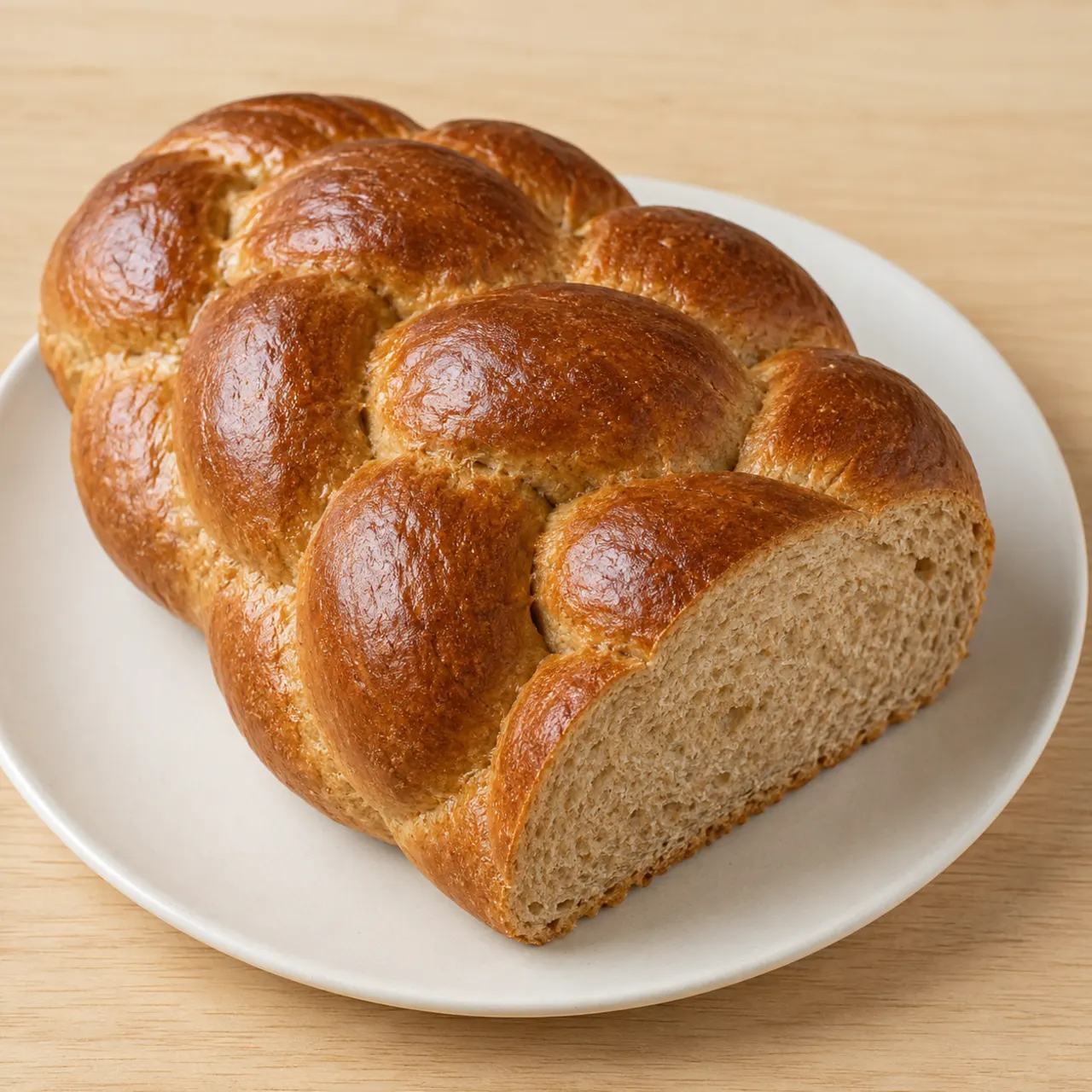
There is a certain satisfaction in pulling a deep golden braid from the oven and realizing it smells like real grain, not dessert pretending to be bread. This unsweetened whole wheat challah keeps the soft pull-apart character people want, but trades the usual sugar hit for a nuttier flavor and a more grounded crumb. It is rich enough from the eggs and olive oil to feel special, yet plain enough to sit beside soup, hold sandwich fillings, or become very decent toast the next morning.
 Breads
Unsweetened Whole Wheat Challah
This whole wheat challah skips the sugar but still bakes up with a tender crumb, a deep wheat aroma, and that familiar braided loaf shape that makes plain sandwich bread look like it gave up years ago. The eggs keep it rich enough for challah territory, while olive oil softens the dough without leaning on butter or sweetness. It is a good fit for a more plant-forward table because the recipe keeps the animal ingredients modest and uses whole grain instead of white supremacist flour.
Ingredients
Preparation Steps
Mix the dough
Warm the water until it feels slightly warm, not hot. Stir in the yeast and let it stand until foamy, about 5 to 10 minutes. In a large bowl, combine the whole wheat flour and salt, then add most of the eggs, the olive oil, and the yeast mixture. Mix until a shaggy dough forms and no dry flour remains. If the dough looks stubbornly dry after a minute or two, keep mixing.
Knead until elastic
Turn the dough onto a work surface and knead until smoother and more elastic, about 8 to 12 minutes by hand or 6 to 8 minutes with a mixer on low. Whole wheat dough will feel firmer than white dough, but it should become supple and only lightly tacky. Keep kneading until the surface looks more even and the dough stretches a little before tearing rather than ripping immediately.
First rise
Place the dough in a lightly oiled bowl, cover, and let it rise in a warm spot until puffed and roughly doubled, about 60 to 90 minutes depending on room temperature. The dough should look rounded and hold a gentle finger dent for a moment before slowly springing back.
Shape the braid
Transfer the dough to the counter and divide it into three equal pieces. Roll each piece into a long rope with tapered ends, line them up, pinch them together at one end, braid, then pinch the other end and tuck both ends slightly underneath. Set the braid on a lined baking tray.
Second rise
Cover loosely and let the braided loaf rise again until visibly puffy, about 45 to 60 minutes. It should feel lighter and the braid should look fuller, with the strands touching more closely; if pressed lightly, the dough should slowly spring back.
Brush and bake
Heat the oven to 190°C. Beat the remaining egg and brush it over the loaf for a glossy crust. Bake for 30 to 35 minutes, rotating once if needed, until the braid is deeply golden brown and sounds hollow when tapped underneath. If it browns too quickly, cover it loosely with foil for the last part of baking.
Cool before slicing
Move the loaf to a rack and let it cool for at least 30 minutes before slicing. The crumb finishes setting as it cools, so cutting too early can make the center feel gummy rather than light and sliceable.
Recipe insights
A braided loaf with actual substance
Why the long rise is worth your patience
The active work here is modest; the clock does most of the waiting while the dough rises for about 2 hours and 40 minutes in total, plus a short cooling time. That rest matters. Whole wheat flour needs time to absorb water properly, which helps the dough move from rough and stubborn to smoother and more elastic. By the second rise, the braid should look fuller and lighter, and after baking the crust turns glossy while the inside stays sliceable rather than dense. Bread has a way of rewarding patience, which is inconvenient but true.
Healthier than standard challah, without becoming bleak
Nutritionally, this loaf leans on whole grain rather than refined flour, which means more fiber, steadier staying power, and a bread that does more than act as a vehicle for toppings. The full recipe provides substantial fiber and a solid amount of protein, with only a small amount of naturally occurring sugar and none added. Using olive oil instead of butter also shifts the fat profile in a more favorable direction. In plain terms: it is bread you can build a meal around.
How it fits the Eat-Lancet idea
From an Eat-Lancet perspective, this is a sensible middle path: mostly whole wheat, modest oil, and a limited amount of egg for structure and color instead of piling on dairy, butter, or sugar. That keeps the loaf closer to a plant-forward everyday bread while still respecting what challah is supposed to feel like. If you want to reduce animal ingredients further, aquafaba can replace the eggs with acceptable results, though the loaf will be a little less rich and less bronzed on top. Not every recipe needs to become a manifesto; sometimes a better default is the more useful victory.

Make room for your own recipes
A little planning. More good food.
Create recipes with ingredients from our nutrition catalogue and see their nutrition and Feast EAT-Lancet alignment score. Keep your favourites, save your nutrition profile, plan meals by hand and take your shopping list with you.
Free accounts can create up to 10 recipes; a higher limit is coming with a paid plan.
Automatic meal generation and household planning are in beta, with limited access.
Comments
Be the first to comment 👇