
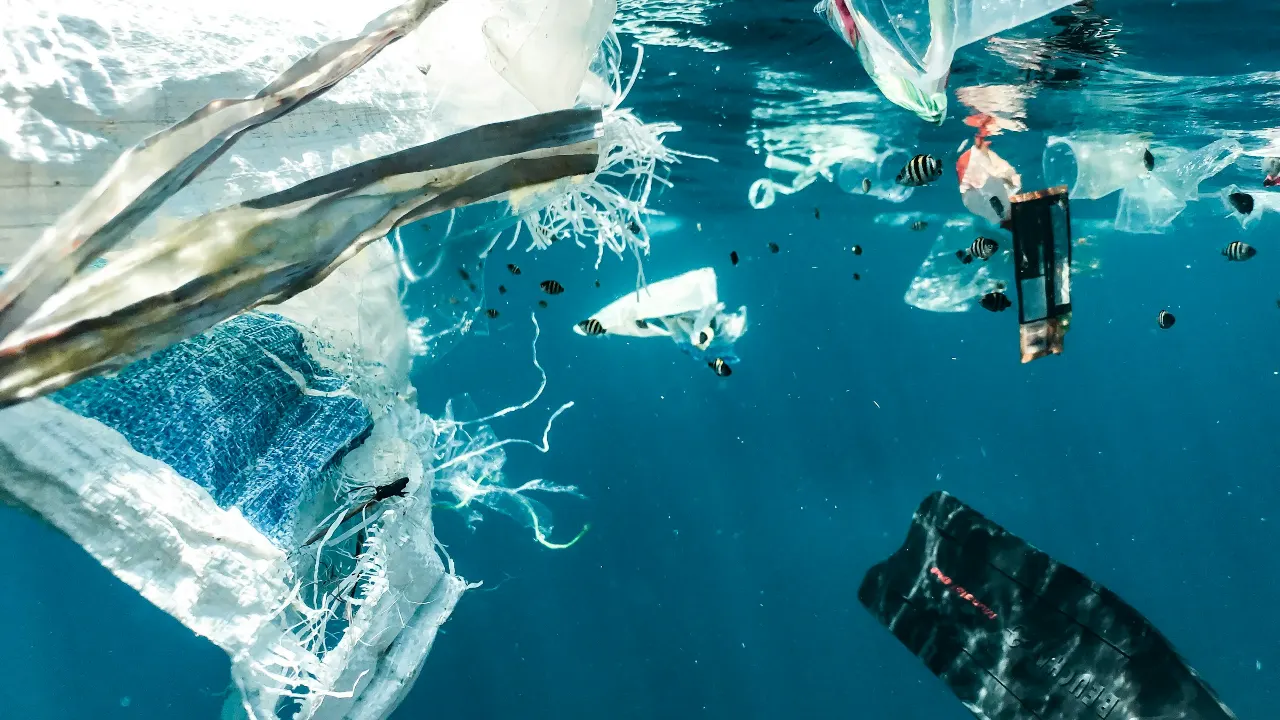
Microplastics: what the term actually describes
Microplastics are plastic particles smaller than 5 millimetres. They're found in water, food, soil and air. Some are barely visible; others are too small to see without specialised equipment. A chopping board, a synthetic fleece and a discarded bottle can all shed them.
Researchers generally call particles from about 1 micrometre to 5 millimetres microplastics. Below that, nanoplastics are commonly described as particles 1 to 1,000 nanometres across, although definitions differ. A micrometre is one-thousandth of a millimetre. The particles can be made of polyethylene (PE), polypropylene (PP), PET, polystyrene or other polymers [EFSA, 2026].
Some start small, such as industrial pellets. Most arise as larger plastic objects break down through friction, heat, sunlight and weathering. Microplastic particles and chemicals that migrate from plastics, such as bisphenols and phthalates, raise different questions about exposure. A 'BPA-free' label tells you little about whether a product sheds particles.
Where microplastics come from before they reach our food
Microplastics begin far beyond the kitchen. Vehicle tyres wear against roads. Synthetic clothes shed fibres. Agricultural films crumble in fields. Plastic waste weathers into smaller and smaller fragments. In an influential global assessment, tyre wear and synthetic textiles were among the major sources of primary microplastics entering the oceans. The figures track pollution reaching the ocean; the pathways into our meals are more complicated [Boucher and Friot, 2017].
Rain washes road particles towards waterways. Wastewater carries textile fibres, even though treatment plants capture many of them. Airborne dust brings fibres indoors. Food testing has reported particles in mussels, meat, vegetables, honey, salt and beer. Drinking water is another route. But comparing one study's numbers with another's is difficult: laboratories isolate different sizes and use different identification techniques [EFSA, 2026].
We also breathe particles in. That makes the popular question 'Which food has the most microplastics?' harder to answer than it looks. Seafood is only one part of the picture. There's also household dust, road pollution and whatever happens while we prepare dinner.
In the kitchen, chopping and heating deserve more attention than the packaging
Microplastics can enter a meal through ingredients and water, then acquire extra particles during preparation. Think about the surfaces that get scratched, stirred or repeatedly heated.
Chopping boards. Plastic boards are cut by knives thousands of times. In a 2023 laboratory study, researchers measured polyethylene and polypropylene fragments produced during chopping. Board composition and cutting style changed the results. Their yearly exposure estimates depend on assumed chopping habits. What they measured directly was the release of fragments as a knife cut into plastic [Yadav et al., 2023].
When I'm developing vegetable-heavy recipes for Feast On The Planet or just casually cooking, the board gets far more action than any piece of food packaging. My practical rule is to favour a well-maintained wooden board for everyday chopping and retire any board once deep grooves are difficult to clean. That also makes sense for hygiene; bacteria from raw ingredients are a better-established kitchen hazard than a hypothetical particle count.
Containers and bottles. Repeated use can scratch plastic surfaces and wear seals. Heating adds a separate issue: some substances can migrate from plastic into hot food. A 'microwave-safe' label indicates suitability for microwave use; it says little about particle shedding. Cold lentils in a storage box and tomato sauce reheated in a battered container are different situations.
Tea bags and tools. Some silky pyramid tea bags contain plastic. One laboratory experiment found extensive micro- and nanoplastic release from the plastic bags it tested when steeped in hot water. Paper and plant-fibre bags vary in their construction. Worn spatulas and plastic blender components add more potential contact points. Their contribution to a typical meal is still poorly measured [Hernandez et al., 2019].
What about non-stick pans? Scratches, PTFE and overheating
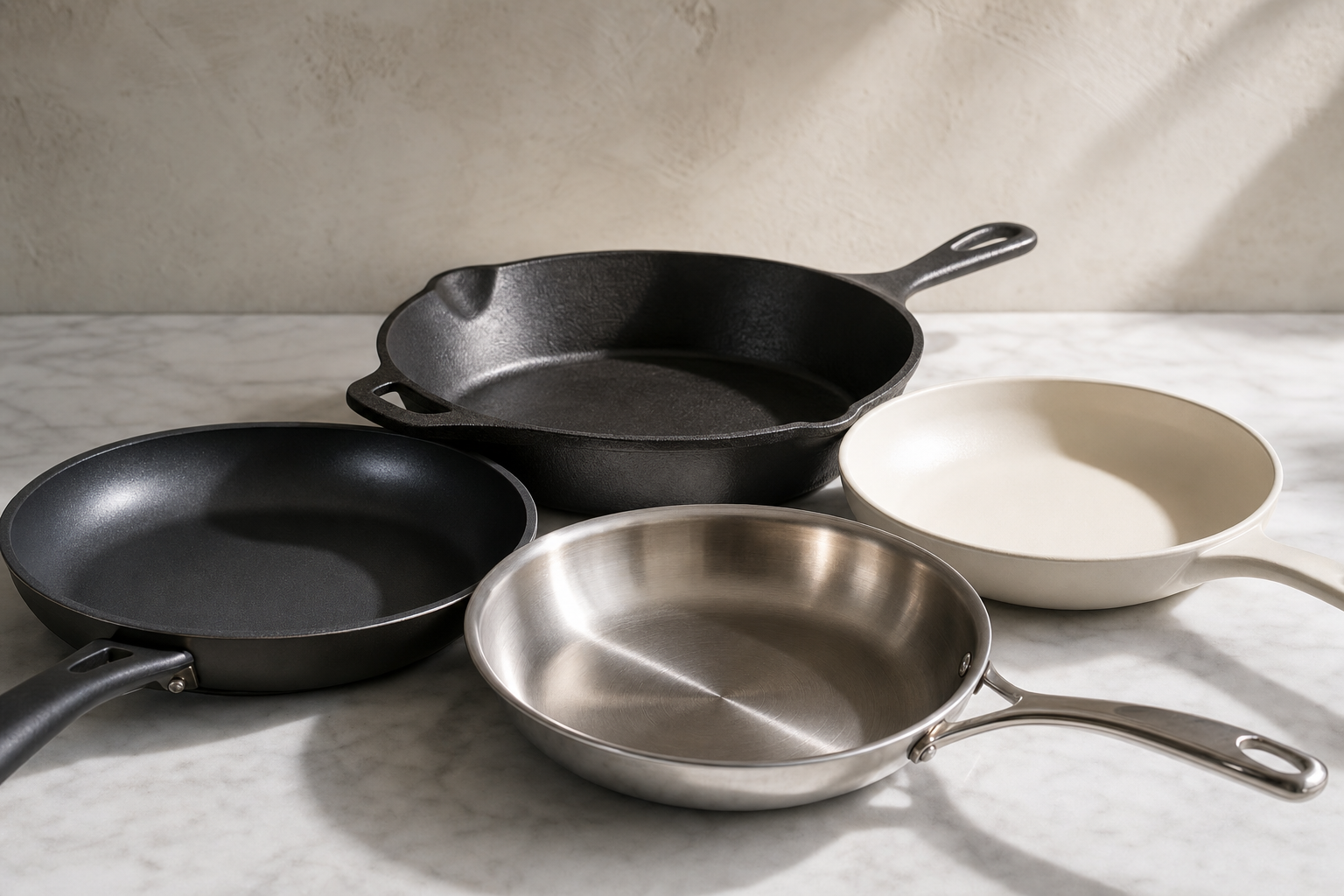
Non-stick pans deserve their own answer. Many conventional coatings use PTFE, the polymer associated with Teflon. PTFE belongs to the broad PFAS chemical family. A solid coating, detached PTFE fragments and small PFAS chemicals involve different forms of exposure. A pan labelled 'PFOA-free' can still contain PTFE.
Can a scratched pan release microplastics? Yes. A 2022 study used Raman imaging to detect PTFE fragments from damaged cookware during simulated use. Depending on the damage and the measurement method, researchers estimated the release of thousands to millions of particles [Luo et al., 2022]. EFSA later identified serious problems with particle identification and counting across food-contact studies [EFSA, 2025].
For everyday use, overheating is the clearer immediate concern. Germany's Federal Institute for Risk Assessment (BfR) considers properly used PTFE cookware safe, even if tiny flakes are accidentally swallowed. Overheating is another story. At around 360°C and above, PTFE can break down and release harmful gases. Never leave a coated pan empty on a high-powered burner, especially on induction or gas [BfR, 2025].
My approach is simple: don't use non-stick pans, there are many alternatives. For the lentils, vegetables and sauces I cook most often, uncoated stainless steel works well and removes the coating question entirely. Cast iron is another durable option. Eggs or delicate pancakes may need more technique and a little oil. I go into the trade-offs between stainless steel and cast iron but I mainly use cast iron pans.
What studies found in bottled water, tea and food-contact materials
In 2024, researchers tested bottled water from three brands using imaging sensitive enough to detect especially small particles. Their estimate averaged about 240,000 micro- and nanoplastic particles per litre, roughly 90% of them nanoplastics, across that small set of samples and with a method capable of detecting very tiny fragments [Qian et al., 2024].
The same problem applies to plastic tea bags and chopping boards: a particle count depends on how small a fragment the method can see. Millions of tiny fragments can weigh less than a few larger pieces. A laboratory test tells us about shedding under specific conditions. Assessing the health effects of years of exposure requires a different kind of evidence.
In 2025, EFSA examined 122 papers on particle release from food-contact materials. It found evidence of release under abrasion and from some fibrous structures. But weak controls, contamination and mistaken identification often inflated reported results. The agency concluded that real-world release was substantially lower than many published figures suggested. The data were still too inconsistent to estimate typical exposure from food-contact materials [EFSA, 2025].
When a viral graphic reports millions of particles from a kitchen tool, I look for the test conditions, the material and how researchers identified the fragments before deciding what to buy.
Are microplastics harmful to health? What human research shows in 2026
Microplastics have been detected in human biological samples. Animal and laboratory studies suggest plausible effects involving inflammation, oxidative stress, immune responses and cell function. But the particles, doses and exposure routes used in experiments often differ sharply from the way people encounter them through meals and air [WHO, 2022].
One human study made headlines in 2024. Researchers analysed plaques removed from the carotid arteries of patients who already had vascular disease. During roughly 34 months of follow-up, 20.0% of patients whose plaques contained detectable micro- or nanoplastics experienced a combined outcome of heart attack, stroke or death, compared with 7.5% of those without detected particles. The association remained after adjustment for several risk factors. However, this observational study cannot establish that plastic particles caused the events, and its percentages shouldn't be applied to healthy people [Marfella et al., 2024].
A systematic review published in February 2026 gathered 25 studies that measured particles in samples from living people. It reported associations involving cardiovascular findings, inflammation, sperm quality, gut measures and respiratory outcomes. Most studies were cross-sectional or case-control. There was only one prospective cohort, and differences in methods prevented a meaningful meta-analysis. Confounding and measurement bias remain substantial obstacles [Tran et al., 2026].
The next challenge is to establish everyday doses and follow larger groups for long enough to test whether these associations hold up.
Why particle counts make such bad health headlines
A headline saying 'millions of microplastics' leaves out half the information. Particle size, shape, polymer and mass all affect what the number means. Detecting smaller fragments can send the count soaring even when the amount of plastic by weight changes little.
Laboratories must also guard against their own plastic tubing, sample containers and airborne fibres. Chemical identification matters: a speck that looks like plastic under a microscope could be something else. These shortcomings are central to EFSA's assessment of food-contact studies [EFSA, 2025].
There is also a difference between hazard and risk. A result obtained at a controlled laboratory dose tells us little about the risks of everyday dietary exposure until the doses can be compared. As of October 2026, EFSA has not completed a full health-risk assessment for microplastics in food. Its scientific opinion is expected by the end of 2027 [EFSA, 2026].
What I would replace in a real kitchen, and what I would keep
So, should you replace every piece of plastic in your kitchen? Ideally, yes. If there's a practical alternative made from wood, glass, stainless steel or ceramic, I'd choose it. Plastic is everywhere in modern kitchens, from chopping boards and storage containers to spatulas, kettles and tea bags. Replacing it wherever possible reduces the number of plastic surfaces touching our food, particularly during heating, chopping and stirring.
You don't need to replace everything overnight. But I think a mostly plastic-free kitchen is a sensible goal, and there are plenty of affordable alternatives that last for years.
Here's where I'd start:
1. Food storage: Replace plastic containers with glass jars, glass food containers or stainless-steel boxes. Glass is particularly convenient for leftovers because you can store and reheat food in the same container. Reuse empty glass jars for dry ingredients instead of buying new ones.
2. Chopping boards: Choose a solid wooden board instead of plastic. Wood is durable, can be resurfaced when worn and won't shed synthetic plastic particles under your knife. Wash and dry it properly, and use a separate board for raw meat to avoid cross-contamination.
3. Cooking utensils: Swap plastic spatulas, ladles, spoons and serving tools for wood or stainless steel. They're durable, easy to clean and won't introduce plastic wear particles into your food. Use wooden utensils on delicate cooking surfaces.
4. Frying pans: When buying new cookware, I'd favour uncoated stainless steel, cast iron or carbon steel over non-stick coatings. They can last decades (or your whole life) with proper care. Replace peeling or badly scratched non-stick pans, and avoid overheating those you still use.
5. Tea and coffee: Use loose-leaf tea with a stainless-steel infuser instead of synthetic tea bags. For coffee, a French press or reusable stainless-steel filter can reduce contact with plastic components.
6. Drinking water: Choose a glass or stainless-steel bottle instead of disposable plastic bottles. Where tap water is safe to drink, it's usually the simplest option. Glass bottles and stainless-steel carafes also work well for keeping water in the fridge.
7. Kitchen accessories and cleaning: Replace plastic mixing bowls, colanders and measuring tools with stainless steel or glass. Consider wooden dish brushes with replaceable heads and plastic-free cleaning sponges. Even small changes help reduce the amount of plastic in your kitchen.
My preference is simple: whenever something plastic wears out, replace it with a durable plastic-free alternative. And if a plastic item regularly touches hot food, I'd prioritise replacing that one.
A battered plastic chopping board or peeling non-stick pan is a good place to start.
Comments
Be the first to comment 👇