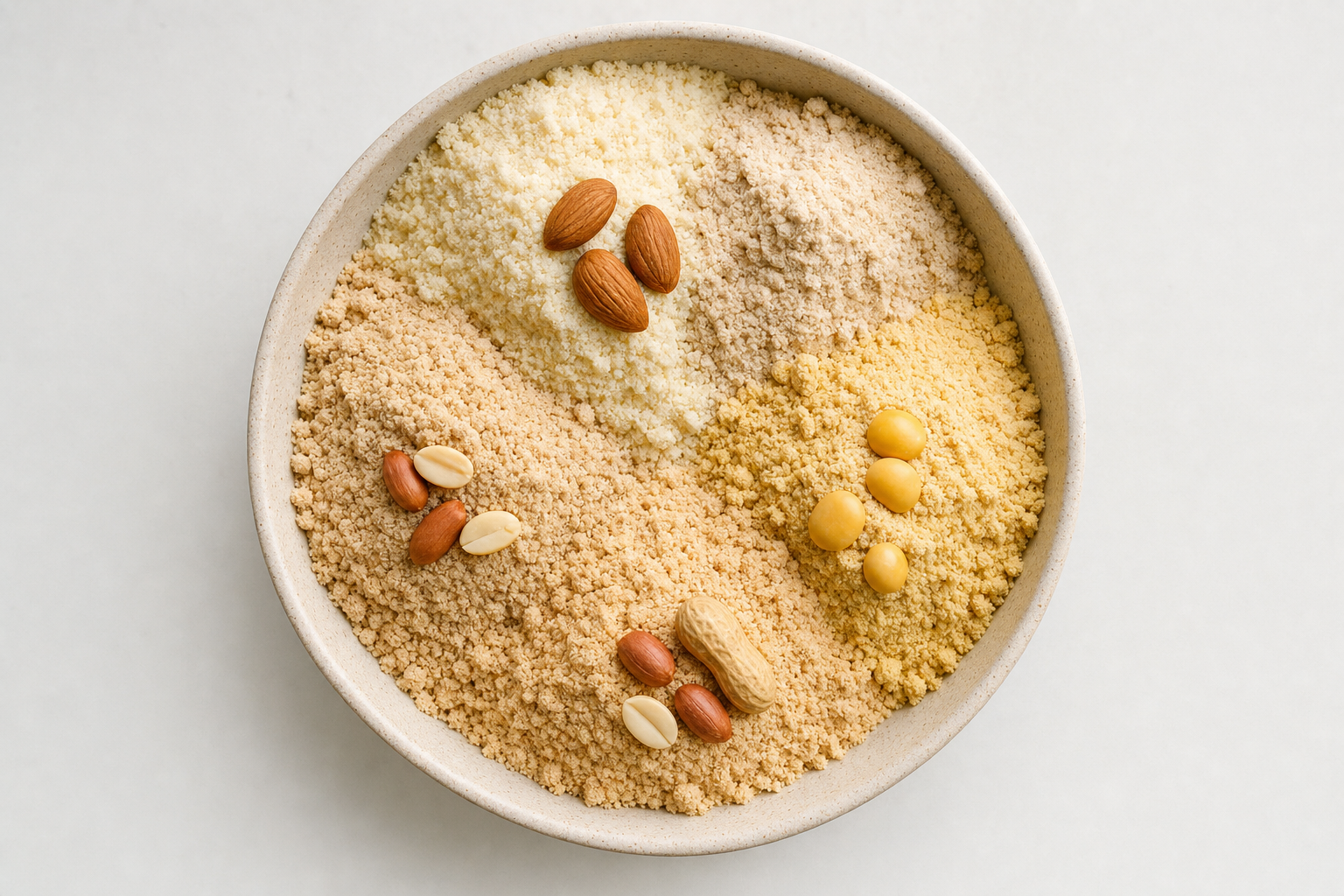
Why I Keep These Flours in the Cupboard
I am not interested in turning every cake into a nutritional sermon, but I do like ingredients that quietly improve the math. Replacement flours can help raise fiber and protein, lower the reliance on refined wheat, and make baking or pancakes a bit more filling. The catch, of course, is that they all behave differently, and some of them have the social skills of wet cement if you use too much. The five I come back to most are almond flour, de-oiled almond flour, lupin flour, peanut flour, and de-oiled peanut flour. They are useful, almost interchangeable, and they each bring their own strengths, limits.
Almond Flour: Rich, Tender, and Not Exactly Cheap
Almond flour is the friendliest one for texture. It adds tenderness, moisture, and a mild sweet nuttiness that works in cakes, muffins, pancakes, tart crusts, and even coatings. Nutritionally, it is lower in starch than wheat flour, relatively high in unsaturated fats, provides some protein, vitamin E, magnesium, and a bit of fiber. It can help with satiety and usually causes a gentler blood sugar rise than refined flour, which is useful for many people, especially in recipes with limited added sugar. The disadvantages are real too: because it is still fairly high in fat and energy density, it is easy to turn a modest snack into a very enthusiastic snack. It is also low in starch, so it does not give the same structure as wheat flour, which means dense results unless the recipe is built for it. From an EAT-Lancet point of view, almonds fit well in a plant-forward pattern, but they should stay part of a varied mix rather than becoming the answer to every baking question on Earth. They can also be expensive, and in some regions almond production raises water-use concerns, so this is not the flour for casual, bucket-sized banana bread experiments.
De-Oiled Almond Flour: More Protein, More Fiber, Less Forgiveness
De-oiled almond flour, sometimes sold as partially defatted almond flour, is what happens when almond flour gets serious. Some of the fat is removed, which usually concentrates the protein and fiber per 100 grams while lowering the calorie density compared with standard almond flour. That makes it attractive if your goal is to improve the nutritional profile of baked goods without relying only on starches. It can be useful in muffins, protein pancakes, crackers, or mixed into bread recipes in smaller amounts. The downside is texture: less fat means less tenderness, so it can taste drier and a bit more austere. In other words, it behaves like a highly motivated ingredient that forgot pleasure matters. It also does not bind like wheat flour, so it usually works better blended with other flours than used alone. Environmentally, the same almond questions remain, though using a de-oiled product can be seen as part of fuller ingredient utilization. Still, price and availability can be limiting, and the flavor is less lush than regular almond flour.
Lupin Flour: The Protein Champion With a Strong Personality
Lupin flour is one of the most interesting replacement flours if your priority is protein and fiber. Made from lupin beans, it is naturally gluten-free, very high in protein, often very high in fiber, and generally low in digestible carbohydrate. It can be helpful for satiety, blood sugar management, and boosting the nutritional value of breads, savory bakes, pancakes, or flatbreads. It also aligns quite nicely with EAT-Lancet thinking because legumes are exactly the sort of food group we should be leaning on more often: efficient, plant-based, and nutritionally useful. Now for the less glamorous truth: lupin flour has a distinct flavor that can read earthy, slightly bitter, or beany if overused. Start modestly, because going all in can produce a bake that tastes like your pantry has opinions. It can also create dryness, and some people experience digestive discomfort if they suddenly increase legume fiber too fast. There is also an allergy point worth taking seriously: lupin can cross-react in people with peanut allergy, so this is absolutely not an ingredient to introduce casually if allergies are in the picture.
Peanut Flour: Toasty, Useful, and Better Than It Sounds
Peanut flour is underrated. It brings a roasted, warm flavor that works beautifully in cookies, pancakes, snack bars, smoothies, satay-style sauces, and some cakes where a nutty profile is welcome. Nutritionally, it usually offers more protein than standard wheat flour and some fiber, along with minerals such as magnesium and a little potassium. Depending on the product, it may still contain a fair amount of fat, though usually less than peanut butter and sometimes less than whole peanut meal. That gives you flavor without needing huge amounts. From an EAT-Lancet angle, peanuts are legumes, not tree nuts, and they fit well into a plant-forward pattern when used sensibly. The downsides: it tastes like peanuts, which sounds obvious, but it matters more than people think. This is not a neutral flour, so it can dominate delicate flavors. It also does not replace wheat flour one-to-one in baking structure, and allergy concerns are severe enough that peanut flour should never be treated as a casual swap in food shared with others. Cost is often more reasonable than almond products, which gives it a practical advantage for family cooking.
De-Oiled Peanut Flour: Leaner, Higher Protein, and Very Handy
De-oiled peanut flour is the one I reach for when I want the protein boost more than the richness. Once part of the fat is removed, the flour becomes more protein-dense and often more concentrated in flavor. It is excellent in small amounts in muffins, brownies, pancakes, homemade protein bakes, porridge additions, or savory sauces where you want peanut character without pouring in lots of fat. For people trying to increase protein intake while keeping calories in check, it can be genuinely useful. It also tends to be budget-friendlier than many specialty flours, which is refreshing in a market that occasionally prices flour as if it had been hand-delivered by monks. The trade-offs are texture and versatility: because it has less fat, it can make baked goods dry or chalky if pushed too far, and the peanut taste is still very present. Like the other flours here, it does not provide gluten structure, so it performs best as part of a blend. Allergy concerns remain exactly the same, and that alone makes it unsuitable for many households or school snacks.
So Which One Is Best? Annoyingly, It Depends
If I want tenderness and richness, almond flour wins. If I want a stronger fiber and protein lift with less fat, de-oiled almond flour is more efficient. If I want the biggest nutritional upgrade in protein and fiber from a plant perspective, lupin flour is hard to beat, provided the flavor works for the recipe and no allergy risk is involved. If I want affordability plus a warm roasted taste, peanut flour is excellent. If I want an even leaner, more protein-focused version of that same idea, de-oiled peanut flour is the practical choice. None of these is a magic ingredient, and none needs to replace wheat entirely. In a realistic EAT-Lancet kitchen, they are tools: useful for shifting recipes toward more legumes, nuts, fiber, and protein, while still keeping food enjoyable. Because if the nutrition is brilliant but the muffin tastes like a compromise wearing a cardigan, nobody is coming back for a second one.


Comments
Be the first to comment 👇