Planetary Health Diet vs. Vegan Diet: What Actually Changes?
The short version
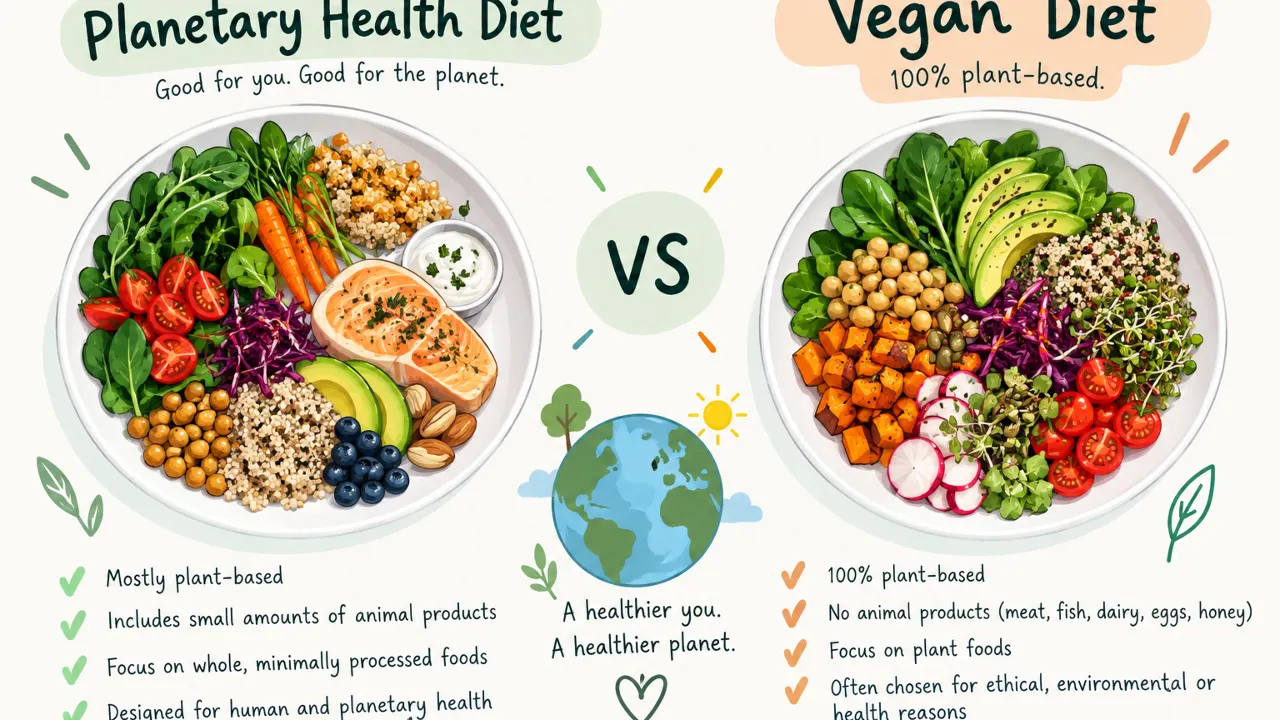
A vegan diet excludes all animal-derived foods: meat, fish, dairy, eggs, and usually ingredients such as gelatine. The Planetary Health Diet, developed by the EAT-Lancet Commission, is plant-forward rather than strictly vegan. It puts vegetables, fruit, legumes, whole grains, nuts, and unsaturated oils at the centre, while allowing modest amounts of dairy, eggs, fish, poultry, and red meat. It is a flexible reference pattern, not a purity test. [EAT-Lancet Commission, 2025]
What they have in common
Both approaches can move meals away from meat-heavy defaults and toward beans, lentils, grains, vegetables, nuts, and fruit. Both can reduce reliance on red and processed meat, and both can be built around familiar food rather than specialist imitation products. A vegan diet can look very close to the Planetary Health Diet when it is based on minimally processed plant foods; the main dividing line is that veganism removes animal foods entirely, while the Planetary Health Diet limits them.
The real difference is the goal
Veganism is defined by exclusion of animal products, often for ethical reasons, although people may choose it for health, environment, religion, or taste. The Planetary Health Diet was designed as a population-level framework that links dietary health with food-system sustainability and equity. It asks less, “Is this animal-derived?” and more, “How often, how much, and what does this food system require?” [EAT-Lancet Commission, 2025]
Neither label does the cooking for you
Neither diet name guarantees a nutritious or low-impact plate. Vegan biscuits, sugary drinks, and heavily packaged meat substitutes are still vegan. Likewise, a Planetary Health Diet built around premium imported convenience food can miss much of the point. Food impacts also vary substantially among producers, so labels alone are a poor substitute for looking at what is actually being eaten and how it is produced. [Poore and Nemecek, 2018]
Which one makes sense?
Choose veganism if avoiding animal products is a firm ethical or personal boundary. Choose the Planetary Health Diet if you want a practical plant-rich pattern that leaves room for occasional eggs, yoghurt, fish, or meat without treating one omelette as a moral collapse. In both cases, the useful work is the same: make plants the default, cook legumes and whole grains well, and reserve industrial convenience food for what it is : convenient, not enlightened.



Comments
Be the first to comment 👇